The New Manufacturing Map: Why US Companies Are Betting on Vietnam, Thailand, and Indonesia to Replace China
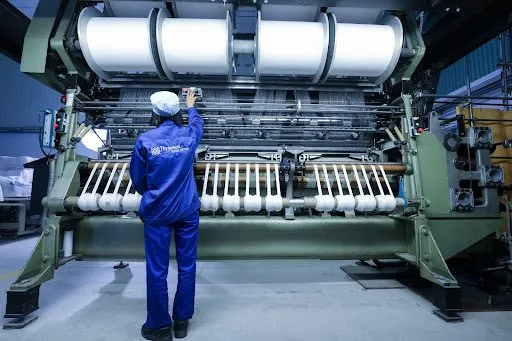
Photo: Thygesen Textile Vietnam, CC BY 4.0, via Wikimedia Commons
Walk through the electronics section of a major American retailer today and you will encounter something that would have been nearly unthinkable a decade ago: product labels reading "Made in Vietnam," "Assembled in Thailand," and "Manufactured in Indonesia" sitting alongside — and in some categories, outnumbering — goods stamped with the familiar "Made in China" designation. This is not a coincidence. It is the visible result of a deliberate, multi-year strategic realignment that US companies have undertaken at considerable expense and organizational effort.
The forces propelling this shift are well-documented: the Section 301 tariffs introduced during the Trump administration and largely sustained under President Biden, the supply chain disruptions that exposed the fragility of single-country sourcing during the COVID-19 pandemic, and the escalating geopolitical tension between Washington and Beijing that has introduced long-term uncertainty into any business calculation dependent on stable US-China trade relations. What is less well understood is the operational reality of executing this transition — the country-specific advantages and limitations, the hidden costs, and the strategic frameworks that distinguish successful relocations from expensive missteps.
Why Southeast Asia, and Why Now
The appeal of Southeast Asia as a manufacturing alternative to China is not a recent discovery. Japanese and South Korean companies began diversifying into the region decades ago. What has changed is the scale and urgency of American corporate interest, and the degree to which Southeast Asian governments have actively positioned their economies to capture this redirected investment.
Vietnam has emerged as the most prominent beneficiary of supply chain diversification, and its ascent has been striking. The country's exports to the United States grew from approximately $12 billion in 2010 to over $114 billion in 2022, according to US Census Bureau data. Electronics, footwear, apparel, and furniture account for the largest shares. Companies including Samsung, Intel, LG, and a growing roster of US brands have established or expanded Vietnamese manufacturing operations, creating an industrial base that has matured considerably in both capability and workforce sophistication.
Thailand occupies a different but complementary position. Its established automotive and hard disk drive manufacturing clusters reflect decades of investment and supply chain development. For US companies in sectors requiring precision engineering, Thailand's technical workforce and existing supplier ecosystems offer advantages that newer industrial markets cannot yet replicate. The country's relatively stable political environment and well-developed logistics infrastructure — including the Laem Chabang deep-sea port — further support its case for capital-intensive manufacturing investment.
Indonesia, meanwhile, represents perhaps the largest long-term opportunity, though also the most complex near-term operating environment. With a population exceeding 270 million and abundant natural resources including nickel — a critical input for electric vehicle batteries — Indonesia has attracted substantial interest from US companies in the clean energy supply chain. The government's downstream processing requirements, which mandate that raw materials be refined domestically before export, have created both friction and incentive for foreign manufacturers to establish local operations.
A Country-by-Country Cost Analysis
For US supply chain executives conducting location assessments, the financial calculus across Southeast Asia varies significantly and resists simple generalization.
Labor costs in Vietnam have risen steadily as the country's manufacturing sector has matured. Average monthly wages in Vietnamese manufacturing zones now range from approximately $250 to $350, compared to $500 to $700 in coastal Chinese provinces — still a meaningful differential, but narrowing. More importantly, Vietnamese labor productivity in established industries has improved substantially, meaning that raw wage comparisons can be misleading without adjusting for output per worker.
Thailand's labor costs are higher than Vietnam's, with manufacturing wages averaging $400 to $600 per month, reflecting the country's more advanced industrial development. Companies that have evaluated Thailand tend to emphasize total cost of ownership rather than unit labor cost, factoring in lower defect rates, established quality management systems, and proximity to regional logistics hubs.
Indonesia presents the most heterogeneous cost profile. Labor costs vary dramatically between Java — where most industrial activity is concentrated — and outer islands where the government is actively promoting new special economic zones. Logistics costs in Indonesia remain elevated relative to Vietnam and Thailand, a function of the archipelago's geography and the ongoing development of inter-island transport infrastructure.
Beyond wages, US companies consistently flag land acquisition, permitting timelines, and utility reliability as critical variables. Vietnam's industrial park system has streamlined much of this process for foreign investors, while Indonesia's bureaucratic complexity, despite significant reform efforts under President Joko Widodo's administration, continues to extend project timelines.
Voices from the Supply Chain
Supply chain consultants who work with US companies on Southeast Asian relocation projects describe a pattern of initial optimism followed by a more nuanced operational reckoning.
"The companies that struggle are usually the ones that treat this as a simple geographic substitution," noted one senior consultant at a global logistics advisory firm, speaking on background. "They assume that because wages are lower and tariff exposure is reduced, the economics will automatically work. The reality is that supplier development, quality systems, and logistics integration require significant upfront investment and a longer runway to profitability than most finance teams initially model."
A supply chain director at a mid-sized US consumer electronics brand, whose company completed a partial relocation from Guangdong Province to northern Vietnam over a three-year period, described the experience as ultimately successful but more demanding than anticipated. "Our Vietnamese factory now produces at quality parity with our Chinese operations. But getting there required sending our most experienced engineers to Hanoi for extended periods, rebuilding our quality assurance protocols from the ground up, and accepting higher unit costs for the first eighteen months while the workforce came up the learning curve."
Practical Guidance for US Businesses Considering the Transition
For American companies evaluating Southeast Asian manufacturing investment, several practical principles emerge from the experience of early movers.
Begin with a rigorous product-market fit assessment for each potential country. Not every product category translates cleanly across manufacturing environments. High-precision electronics may be better suited to Thailand's established ecosystem, while labor-intensive assembly operations may find Vietnam's workforce depth more advantageous. Commodity-driven products linked to natural resource inputs may point toward Indonesia.
Engage regional legal and regulatory counsel before committing capital. Foreign ownership restrictions, repatriation rules, and sector-specific licensing requirements differ substantially across ASEAN member states. The cost of expert guidance at the assessment stage is trivial compared to the expense of structural mismatches discovered after investment decisions are made.
Invest in supplier development, not just factory establishment. One of China's enduring manufacturing advantages is its dense supplier ecosystem, which allows rapid component sourcing and product iteration. Southeast Asia is developing analogous networks, but they remain less mature in most sectors. US companies that commit to building local supplier relationships — rather than simply importing Chinese components into Southeast Asian assembly facilities — will develop more resilient and cost-competitive operations over time.
Finally, treat the "China plus one" framing with appropriate skepticism. For most US companies, complete decoupling from Chinese manufacturing is neither practical nor desirable in the near term. A more defensible strategy involves deliberate diversification — maintaining Chinese operations for domestic Chinese market supply while building Southeast Asian capacity for US-bound production. This dual-track approach reduces tariff exposure and geopolitical risk without sacrificing the scale efficiencies that Chinese manufacturing still provides in many categories.
The Broader Strategic Picture
The restructuring of US-oriented supply chains toward Southeast Asia is not merely a corporate efficiency exercise. It is reshaping the economic development trajectories of Vietnam, Thailand, and Indonesia in ways that will have lasting consequences for regional prosperity and US commercial engagement with Southeast Asia.
At SuriaLink, we view this supply chain realignment as one of the most significant structural developments in the US-Southeast Asia commercial relationship in a generation. American companies that approach regional expansion with the depth of preparation and cultural engagement that the opportunity demands are not simply reducing supply chain risk — they are building durable commercial relationships with some of the world's most dynamic economies. Those that treat Southeast Asia as a convenient tactical hedge, rather than a strategic priority, are likely to find the region's complexity more punishing than rewarding.